

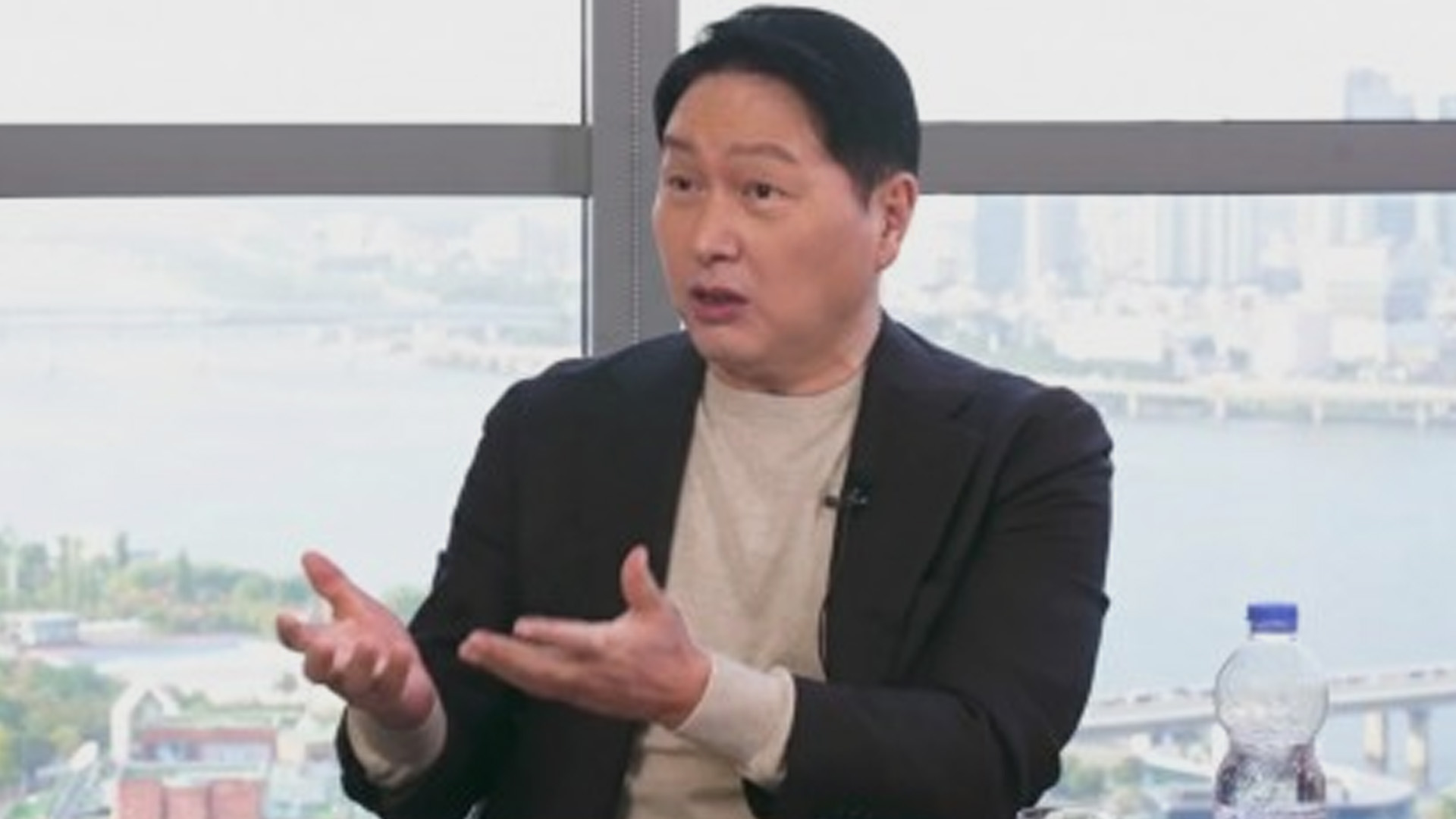






SK Group Chairman Chey Tae-won said Sunday the upcoming business gathering on the sidelines of the Asia-Pacific Economic Cooperation (APEC) summit in South Korea will serve as an opportunity for global companies to find ways to address protectionism.
“The APEC CEO Summit will serve as a venue where 1,700 participants will seek answers in the era of protectionism,” Chey, who also serves as head of the Korea Chamber of Commerce and Industry (KCCI), said during a group interview with YouTube channels.
The KCCI will host the APEC CEO Summit from Tuesday to Friday in Gyeongju, about 275 kilometers southeast of Seoul, on the sidelines of the APEC summit, which will bring together delegations from 21 member economies.
Chey said the APEC summit is especially significant as it will offer clues on how issues between the United States and China may unfold over the next few years.
“The leaders of APEC members, including U.S. President Donald Trump and Chinese President Xi Jinping, are set to hold discussions on various agendas,” Chey said.
Trump and Xi are expected to hold talks during the APEC event, marking their first meeting amid intensifying tit-for-tat trade tensions.
Touching on the prospects for the South Korean economy, Chey underscored the need for Seoul to expand cooperation with Japan to address protectionism and economic fragmentation.
“Free trade cannot be restored under the World Trade Organization regime as it was in the past,” Chey said. “Export-oriented growth, which has continued since the 1960s, no longer functions due to tariffs.”
Chey added that South Korea and Japan can achieve an economy of scale by generating a market estimated at US$6 trillion and jointly addressing external uncertainties.
To further boost economic growth, Chey said South Korea needs to expand investment in the artificial intelligence industry.
“(The United States and China) will not stop their investment war in the AI (artificial intelligence) sector,” Chey said, adding that the competition is reminiscent of the military spending competition between Washington and Moscow during the Cold War.
“Despite geopolitical uncertainties, we need to continue making necessary investments,” Chey added. “Falling behind in the AI sector poses a significant risk, and we intend to continue making related investments.” (PNA)