
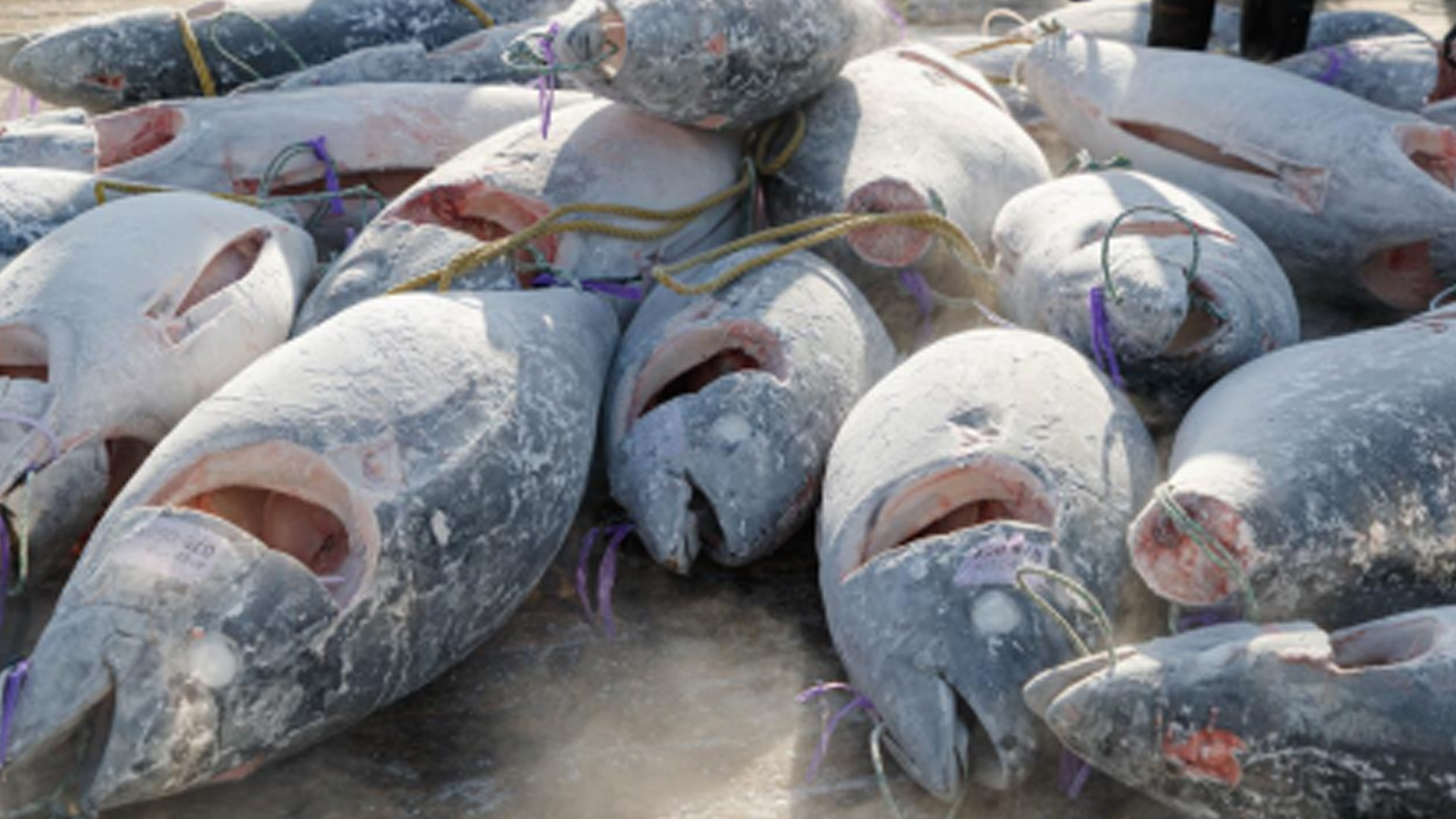








A Japanese fishing industry group is seeking to raise the profile of southern bluefin tuna, including by rebranding it as “Antarctic tuna.”
Southern bluefin is regarded as the second-highest-quality tuna, after Pacific bluefin, but is not well known among consumers. In Japan, it is also known as Indian tuna, because it is caught mainly in the Indian Ocean.
The fish is usually frozen after being caught and transported to markets such as the Toyosu wholesale market in Tokyo, where it can fetch high prices almost on par with those of Pacific bluefin tuna.
Despite its high quality, the fish is often served without being labeled as southern bluefin tuna due to its low name recognition compared with Pacific bluefin tuna and because its name evokes warm oceans, according to a fishing industry source.
Japanese distant-water longline fishing ships catch southern bluefin tuna in waters at latitudes of 30 to 45 degrees south, where sea surface temperatures stand at as low as around 10 degrees Celsius. They operate for over half a year before returning to port.
While fishing ships for Pacific bluefin tuna land catches at ports across the country, southern bluefin tuna fishing vessels do so only at certain ports, such as Yaizu Port in Shizuoka Prefecture, central Japan, contributing to the fish’s low profile.
According to the Tokyo-based Japan Tuna Fisheries Co-operative Association, about half of Japan’s 130 distant-water longline tuna fishing vessels catch southern bluefin tuna. The fish’s price at Yaizu Port as of July stood at around 1,600 yen per kilogram, about 30 percent lower than three years before, resulting in low profitability.
The association decided to consider renaming the fish, in collaboration with fishery workers and distributors, to improve its image and popularity.
Various names will be mulled, including Antarctic tuna, inspired by the fact that the fish is caught in waters closest to the Antarctic among all tuna species.
Japanese labeling rules require that for fish, the standard Japanese name or a more widely used name can be adopted, according to the Consumer Affairs Agency’s Food Labeling Division. This means that southern bluefin tuna cannot be labeled with only the possible alternative name until it becomes widely acknowledged.
“We want many people to know that southern bluefin tuna is a natural high-quality tuna caught by Japanese vessels in distant cold waters and frozen at minus 60 degrees,” Kenji Kagawa, head of the association, said.
The association plans to hold an event related to southern bluefin tuna in Tokyo later this year. (PNA)