
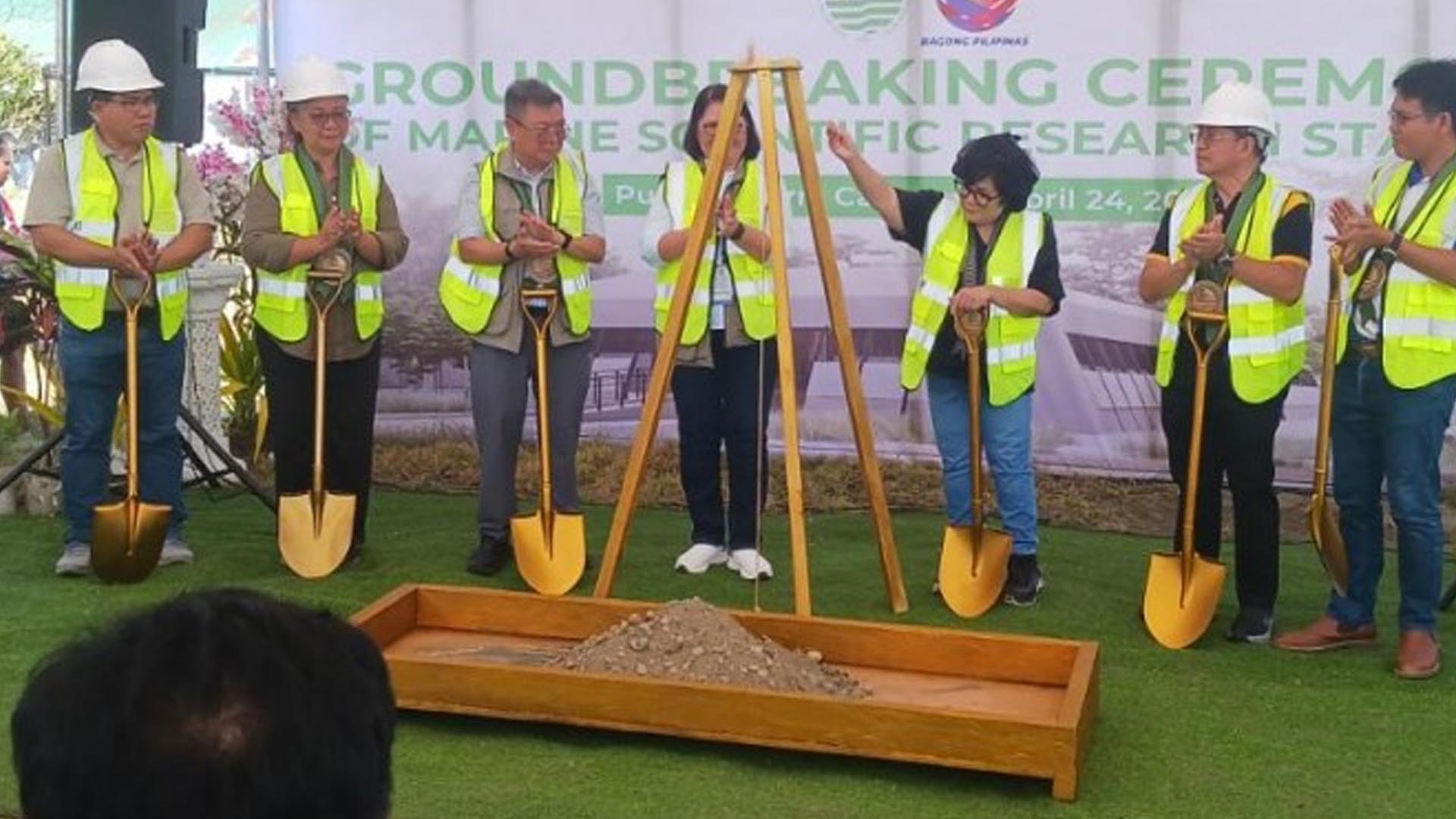








A new marine scientific research hub in northern Luzon is seen to become a game-changer for the Philippines’ blue economy, with its potential to unlock marine resource opportunities while strengthening economic resilience of coastal communities.
Department of Environment and Natural Resources (DENR) Secretary Maria Antonia Yulo Loyzaga on Thursday led the groundbreaking ceremony of the Marine Scientific Research Station (MSRS) in this town, which is part of the government’s broader marine conservation strategy.
She said the facility is envisioned to become a research and innovation center for sustainable ocean resource development.
“This station is more than the physical structure, it is a symbol of commitment to evidence-based governance, to regional and global collaboration, and to securing a resilient future for our coastal communities and our marine biodiversity,” Loyzaga told the Philippine News Agency in an interview.
“The whole point is that you have 30 million hectares of land, but you have 220 million hectares of water. Wala talagang masyadong (we do not have much) research agenda,” she said.
Loyzaga noted that the DENR has organized an Ocean Environment Task Force, which is the main body that would guide the work the department is doing.
She also revealed that eventually, the goal is to establish an Ocean Bureau to institutionalize marine resource governance, which is similar to how the department oversees forests and minerals.
“These ecosystems must be measured so that we can treasure them correctly. They are the lifelines of millions of Filipinos who depend on them for food, livelihood, protection, cultural identity,” Loyzaga said.
The station sits at the confluence of the Cagayan River and the biologically rich Babuyan Channel, a key fishing ground known for its “aramang” or spider shrimp.
She said the MSRS will support blue economy initiatives through deep sea research, biodiversity mapping, and climate monitoring.
With an initial PHP50 million budget secured for the construction of each MSRS facility, Loyzaga said there is a projected annual research allocation of PHP5 to PHP10 million.
The station will host multidisciplinary teams comprising scientists, researchers, and other stakeholders that would contribute to the creation of informed policies, improve fisheries management, and explore new marine industries.
On Wednesday, Loyzaga also spearheaded the groundbreaking ceremony of another MSRS in Casiguran town, Aurora province.
She noted that the research stations are not just for scientists, but more importantly, for the fisherfolk, the youth, and the communities that live by and from the seas. (PNA)