
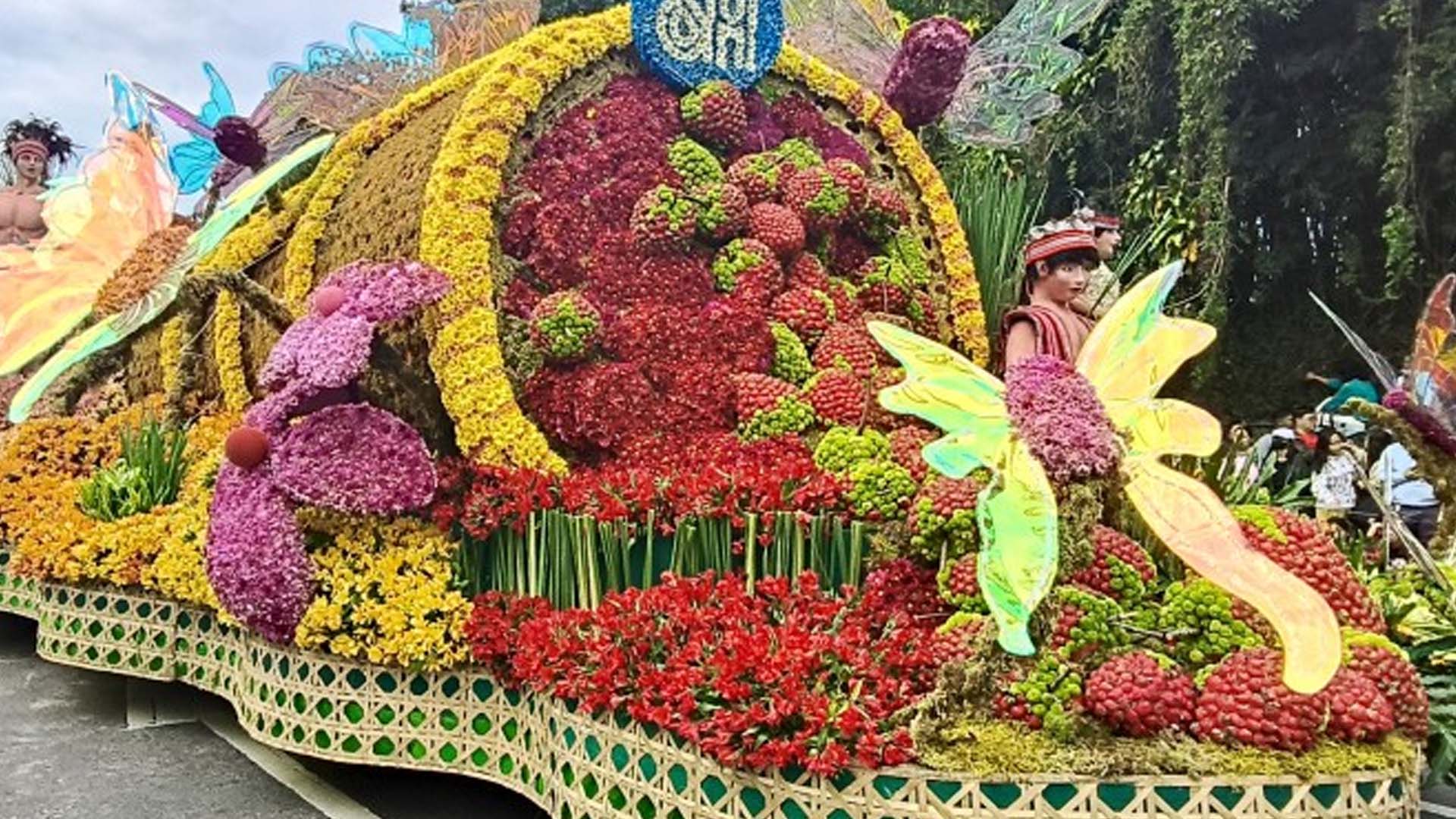








As the years go by, festival floats have become more and more elaborately decorated in the Philippines.
From simple motor vehicles that carried the pretty “sagala” (girl taking part in the procession, usually wearing a gown) in the old days, they have become gigantic rolling flowery things designed to make spectators’ jaws drop.
Romy Chua, who has been in charge of the floats of the Baguio Country Club (BCC) for decades, said float-making is a growing industry that is in constant need of more manpower.
“The demand for florists [and] landscapers is increasing aside from the demand for different themes of floats,” Chua told the Philippine News Agency in a recent interview.
Chua knows what he spoke of. After all, he is the reason why the BCC is a Hall of Fame awardee in the famed Panagbenga Flower Festival.
“I am proud to say that I made the floats that gave Country Club the Hall of Fame and I still continue to make their floats,” he said.
Aside from BCC floats, Chua also said he is also the brains behind several flower floats that left the audience in awe during the Kadayawan Festival in Davao City.
However, Chua said the years are catching up with him and he, as well as other veteran float-makers, may need to hand over the task to a younger generation soon.
“I am getting old. Younger people need to learn it (float-making) and replace us,” he said.
Chua said the art of making floats “cannot be taught through books. It has to be a hands-on training.”
Skills and practical know-how, he said, are a must.
“They need to also learn the basics like landscaping, use of flowers, the nature of flowers considering their high perishability, and timing of all activities related to float-making,” he said.
He said he had students who used to help him in the past but are now being commissioned to do floats.
“I am just overseeing them now because they already learned the process and the system. They are also training others now,” Chua said.
Evangeline Payno, chief of staff of the Baguio Flower Festival Foundation, said as part of the 2026 Panagbenga Festival, also the event’s 30th anniversary, they will hold trainings on float-making to meet the increasing demand for talented individuals.
“We have to adopt because we can see an increasing trend of the participants. We need to have the available skills so that we can assist our participants,” she said in a recent press conference.
She said they would invite flower growers in Benguet to join the training for possible participation in float-making, not just as provider of raw materials.
Vivien Celso, a business owner who participated in a fluvial parade on Feb. 27, said the training would help them in further improving their floats in the coming years.
“It is quite expensive to hire a professional float-maker and we want to participate in the festival even with limited funds,” she said.
“We have evolved from ordinary boats to fiberglass boats and we are willing to improve our participation as our contribution to the festival of Baguio, where we also derive our livelihood,” she said. (PNA)