
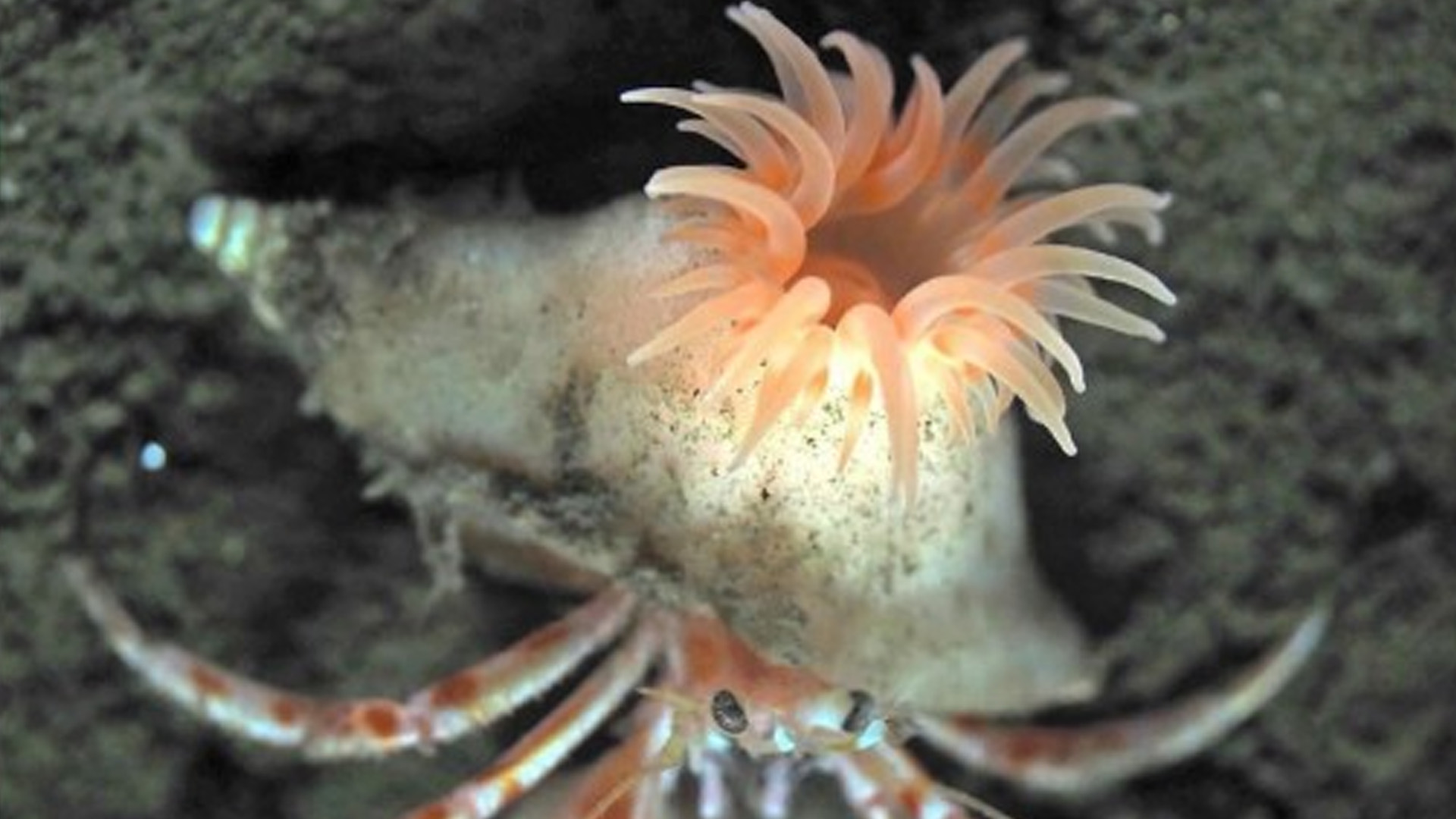








A research team led by Kumamoto University has discovered a new species of sea anemone collected from the deep seabed off the coast of Japan.
The sea anemone attaches itself to a shell inhabited by a certain species of hermit crab, according to the team of researchers.
The team said the sea anemone and the hermit crab species share a symbiotic relationship. According to the researchers, the sea anemone’s secretions help build up the shell and thus help the hermit crab grow, and the sea anemone feeds off the hermit crab’s waste.
The team has named the sea anemone “Paracalliactis tsukisome,” after “tsukisome,” a term for a pale pink color mentioned in a poem from “Manyoshu,” the oldest existing collection of “waka” Japanese poems.
The team’s findings were published in the British Royal Society’s Open Science journal on Wednesday.
Akihiro Yoshikawa, who is an associate professor at the university, and other members of the team collected specimens of the sea anemone attached to shells occupied by hermit crabs at depths of 200 to 500 meters in the Kumano-nada Sea off Mie Prefecture, western Japan, and in Suruga Bay off Shizuoka Prefecture in central Japan.
In past studies, the sea anemone quickly weakened and could not be observed alive by researchers.
The team opted to keep the sea anemone in a facility with an appropriate water temperature and water flow. The sea anemone was identified as a new species through in-depth morphological observation and DNA analysis.
The team also discovered through an isotope analysis of carbon and nitrogen that the sea anemone likely feeds on the feces of hermit crabs.
Many types of hermit crabs move from one empty shell to another as they grow bigger. In the case of Paracalliactis tsukisome, the sea anemone’s secretions harden, causing the hermit crab’s shell to grow larger and benefiting the crab inside.
The team also found that the hermit crab, Oncopagurus monstrosus, is, on average, larger than its closely related species. (PNA)